
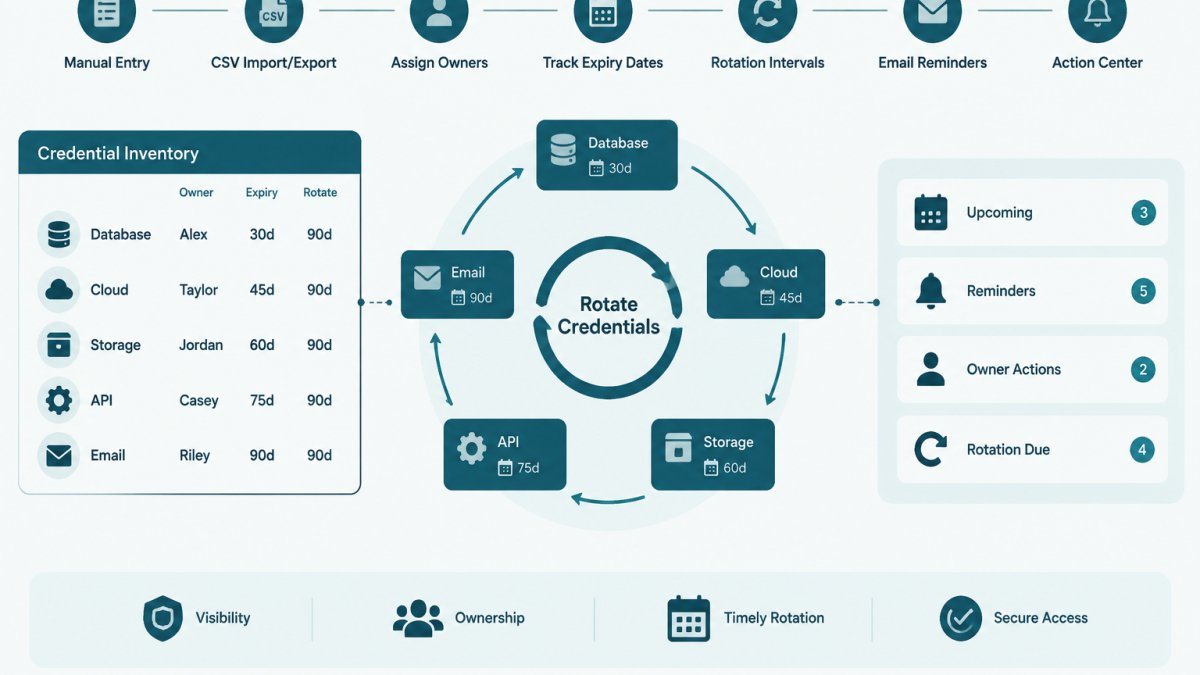
Quick Summary
Choose a rotation workflow for the credential type and target, then check which components can read or store the value. A vault or secret manager can manage supported credentials; short-lived workload credentials can reduce reliance on long-lived keys. KeyGuardRail tracks registered ownership, expiry and rotation metadata while rotation happens in your provider or separate workflow.
- Dynamic credentials need reliable issuance, renewal or replacement, and revocation monitoring. Their broker may still use a long-lived administrative credential that needs its own lifecycle policy.
- A partial rotation can leave the target and stored versions out of sync. Test recovery for that target; a stored previous version does not guarantee a usable rollback.
- Name an owner per key, because a key with no named owner is a key nobody rotates.
- For routine replacement with supported overlap, deploy and verify the new credential before retiring the old one. Suspected compromise can require faster containment.
- KeyGuardRail tracks lifecycle metadata and reminders only; the team performs rotation in the provider and records the outcome.
Table of Contents
- What Secretless Credential Rotation Actually Means
- How Automated Rotation Works in Vaults and Cloud Secret Managers
- Comparing Credential Rotation Tools by Secret-Handling Model
- API Key Rotation Best Practices for Teams Without a Vault
- A Secret Rotation Checklist You Can Run This Week
- Using a Credential Inventory Template to Track Rotation
- Plan Your First Rotation Cycle in KeyGuardRail
- Frequently Asked Questions
What Secretless Credential Rotation Actually Means
“Secretless” can mean different things: no long-lived credential in an application, no secret value in a tracking tool, or a coordinator that triggers rotation without reading the value. These are different boundaries. The component that changes a password or delivers a credential may still handle plaintext in memory.
Use the following models to identify where credentials are handled and which component performs the lifecycle work.
Secret-handling models
Stored-secret management. A vault or secret manager stores protected values and controls access. Rotation coverage depends on the credential type, supported integration and configured workflow.
Short-lived credential issuance. Workload identity and dynamic-secret systems obtain temporary credentials for applications. Those credentials still exist and must be protected during use; the issuer and its own access credentials also need lifecycle management.
For a fuller treatment of the difference between tracking credentials and storing them, see credential management vs secret storage.
How Automated Rotation Works in Vaults and Cloud Secret Managers
There is no single rotation mechanism shared by every vault and cloud service. AWS offers managed rotation and Lambda workflows. Azure Key Vault has native cryptographic-key rotation, while secret replacement needs an appropriate workflow. Google Secret Manager schedules Pub/Sub notifications that a subscriber must act on. Verify target changes and consumer adoption separately from stored-version updates.
Dynamic Secrets and Short-Lived Credentials
Vault’s database secrets engine can issue leased credentials for supported databases. Monitor issuance, renewal and revocation failures, and manage the engine’s own database connection credential. Short-lived application credentials do not remove every long-lived credential from the system.
Cloud providers offer the same idea through identity. AWS documents how IAM roles for workloads issue temporary credentials that expire automatically, and Azure documents managed identities for Azure resources as an equivalent mechanism. Google Cloud's service account impersonation lets a workload obtain short-lived tokens instead of holding a key file.
Applications need a supported way to obtain replacement credentials. A library, agent or sidecar may provide that path; some legacy applications require code changes, while others can reload a rendered credential file. Test the actual consumer behavior.
Static Credentials and Rotation Lambdas
For a long-lived credential, choose a supported managed integration, rotation template or custom workflow. The AWS Secrets Manager rotation guide explains the distinction and the four Lambda stages.
Test failure handling before production use. A failed workflow may have changed the target before failing to promote the stored version. Check the target and stored stages; do not assume that moving a version label restores a revoked credential.
Designing Rotation So the Automation Never Persists Plaintext
Separate the coordinator that triggers work from the privileged component that changes or issues credentials. The following patterns have different custody and operational responsibilities:
-
Reference-only orchestration. A coordinator can request a supported rotation using a secret reference without retrieving its value. This is different from an AWS rotation Lambda: that function reads or writes secret versions and updates the target through the create/set/test/finish contract. Calling RotateSecret alone is not the implementation of that contract.
-
Workload identity. Federation can remove a long-lived application key, but temporary tokens, identity-provider configuration and underlying signing or infrastructure credentials still need protection and lifecycle management.
-
Dynamic credential issuance. A broker obtains or creates temporary access for a workload. Expiry and revocation behavior depend on the provider; verify the consumer’s refresh path and the broker’s own credentials.
-
Metadata-only tracking with human or pipeline execution. The automation system records owner, expiry, and interval, then triggers a reminder or a pipeline run. The actual rotation happens in the provider console or a separate job with its own short-lived access. KeyGuardRail fits here: it tracks lifecycle metadata and reminders, and the team performs the rotation in the provider, then records the outcome.
A common pattern combines patterns 1 and 4: a vault handles rotation for credentials it can custody, and a metadata tracker handles credentials in SaaS providers or legacy systems the vault cannot reach.
Watch out: "secretless" in marketing often means "the automation system doesn't store the value," not "plaintext never exists." The rotation function may still fetch the value into process memory, and it may appear in environment variables, command history, or debug logs.
Comparing Credential Rotation Tools by Secret-Handling Model
Comparing credential rotation tools fairly starts with one question: does the tool take custody of the secret value? Everything else, cloud coverage, credential types, deployment model, auditability, is secondary to that boundary. The table below sorts the main options by where plaintext lives.
| Tool | Stores secret values | Rotation mechanism | Secret-handling boundary | Lifecycle metadata | Deployment model |
|---|---|---|---|---|---|
| HashiCorp Vault | Yes, for stored secrets | Supported engines and plugins; dynamic and static roles vary | Depends on engine and workflow | Available fields depend on engine and configuration | Self-managed or managed offering |
| AWS Secrets Manager | Yes | Managed integrations or Lambda workflows | Rotation Lambda handles values; a coordinator can use references | Tags and rotation/version metadata; verify coverage | AWS-managed service |
| Azure Key Vault | Yes, for secrets; also manages keys/certificates | Native key rotation; secret replacement through a separate workflow | Key operations and secret retrieval are different interfaces | Tags, expiry and version/policy metadata | Azure-managed service |
| Google Secret Manager | Yes | Schedule sends Pub/Sub notification; subscriber performs rotation | Your rotation workflow handles credential changes | Labels, expiration and rotation schedule metadata | Google Cloud-managed service |
| KeyGuardRail | No monitored secret values | Tracks reported lifecycle work; does not rotate provider credentials | Metadata only | Registered owners, expiry, deadlines and evidence | SaaS metadata tracker |
The matrix makes the trade-off visible. Teams weighing the custody boundary directly can read the KeyGuardRail vs HashiCorp Vault comparison.
Selection Criteria Beyond the Custody Boundary
Once you know whether a tool takes custody, the next questions are practical. Use these criteria to narrow the field:
- Cloud and on-premises coverage. AWS Secrets Manager can support non-AWS targets when the rotation implementation, permissions and network access are configured appropriately. Vault also requires target-specific support and connectivity. Test the actual target rather than assume coverage from its hosting location.
- Credential types supported. Verify the exact engine, managed integration, template or provider API. A stored SaaS key is not automatically rotatable, but not every SaaS key requires a manual-only process either.
- Deployment and operating effort. Self-managed and managed offerings have different responsibilities. Even a managed secret service requires correct permissions, target integration, monitoring and consumer updates. A metadata tracker still needs accurate records and accountable owners.
Prefer supported workload identity when it removes an unnecessary long-lived key. For remaining credentials, choose a compatible management workflow, check its custody requirements and test consumer migration and recovery.
Watch out: a tool that stores secrets and a tool that tracks metadata solve different problems, and neither replaces the other.
API Key Rotation Best Practices for Teams Without a Vault
A team can rotate credentials without a centralized vault using a documented provider API or console workflow and a secure delivery path. A CI job does not have to operate through a console. Keep values out of logs and metadata, and verify the provider and consumers.
Start with these rules:
- Name an owner per key. A key with no named owner is a key nobody rotates.
- Record actual expiry separately from policy. If a provider does not expire a credential, record a review or rotation deadline without presenting that date as provider-enforced expiry.
- Choose intervals by risk and requirements. Consider privileges, exposure, provider support and replacement reliability; a credential type alone does not establish its risk.
- Verify the cutover. For routine work with supported overlap, create and deploy the replacement, verify consumers, then retire the old credential. Use a provider-specific recovery plan; compromise can require immediate containment.
- Record evidence. Keep the provider result, consumer checks, responsible owner and completion time. A recorded date alone does not establish successful rotation or compliance.
- Plan offboarding dependencies. Remove a departing person’s access promptly. Check service-account consumers and migrate legitimate workloads before routine retirement; contain suspected compromise promptly.
Keep routine overlap bounded and retire the previous credential once consumers are verified. Two active credentials increase exposure, but do not imply a mathematically doubled time window.
A Secret Rotation Checklist You Can Run This Week
A secret rotation checklist works when it produces evidence, not just activity. Run this one against a single environment first, then widen the scope.
- Export or list every credential in scope, with provider and purpose
- Assign a named owner to each credential
- Record the creation date and any provider-enforced expiry
Verify retirement through the provider’s status and an approved, safe authentication check where appropriate. A failed request alone can also mean a permission, network or configuration problem, so inspect the actual result before recording revocation as complete.
Using a Credential Inventory Template to Track Rotation
A credential inventory template is a structured record of every credential's metadata: provider, purpose, owner, creation date, expiry date, rotation interval, and last rotation date. The value comes from the fields, not the format.
Use the free credential inventory template to collect supported metadata fields. Check the actual CSV columns and import requirements; keep secret values out of the file.
- Provider and credential type so the rotation procedure is findable
- Accountable ownership through a responsible team, named contact and backup or escalation path.
- Expiry and rotation interval so deadlines are calculable
A fictional example row looks like this: provider example-cloud, purpose staging deploy token, owner A. Patel, created 2026-01-15, interval 90 days, last rotated 2026-04-10. No secret value appears anywhere in the record.
Plan Your First Rotation Cycle in KeyGuardRail
Planning a first rotation cycle in KeyGuardRail means recording what exists, assigning owners, setting intervals, and letting reminders drive the work.
The flow is straightforward. Import the inventory by CSV or enter rows manually. Assign an owner to each credential. Set expiry dates and rotation intervals.
Watch out: recording a rotation before it actually happened in the provider turns the audit history into fiction. The short product tour shows the assign-owner, plan-rotation, record-work, and audit-history sequence on a fictional workspace.
Vaults and provider workflows manage credential values and target changes. Metadata tracking records ownership, deadlines and lifecycle evidence. Check the configured coverage of each tool before adding another.
Frequently Asked Questions
Can credential rotation be automated without storing the secret value in a tracking tool?
Yes. A metadata tracker can remain outside the secret-value path while a supported provider workflow, vault or separate job performs rotation. A coordinator may trigger that work using a reference, but the component that changes or delivers the credential can still handle its value. KeyGuardRail records registered ownership, deadlines and lifecycle evidence; it does not rotate provider credentials.
What is the difference between a secrets manager and a credential inventory?
A secrets manager stores the secret value and controls who can retrieve it. A credential inventory stores metadata about the credential: its name, provider, owner, expiry date, rotation interval and last rotation date. The two solve different problems. A vault answers "what is the secret and who can read it"; an inventory answers "who owns this credential, when does it expire, and when was it last rotated." Teams with credentials spread across several providers often need both.
Which tools can rotate credentials automatically in their provider?
Coverage depends on the target and credential type. Vault supports configured engines and plugins. AWS Secrets Manager provides eligible managed integrations and Lambda workflows. Azure Key Vault provides native cryptographic-key rotation, while secret replacement uses a separate workflow. Google Secret Manager sends scheduled Pub/Sub notifications for a subscriber to perform the change. Verify the exact documented support and consumer migration path.
How often should API keys and service account credentials be rotated?
There is no single correct interval. A common approach is to set the interval by blast radius: credentials with broad access or no usage logging get shorter intervals, while narrowly scoped keys used by one service can go longer. Whatever interval you pick, record it against the credential so the next rotation is scheduled rather than remembered. Short-lived credentials issued on demand reduce the need for scheduled rotation entirely, because expiry is built into the credential.
