
Last Updated: October 26, 2026
Quick Summary
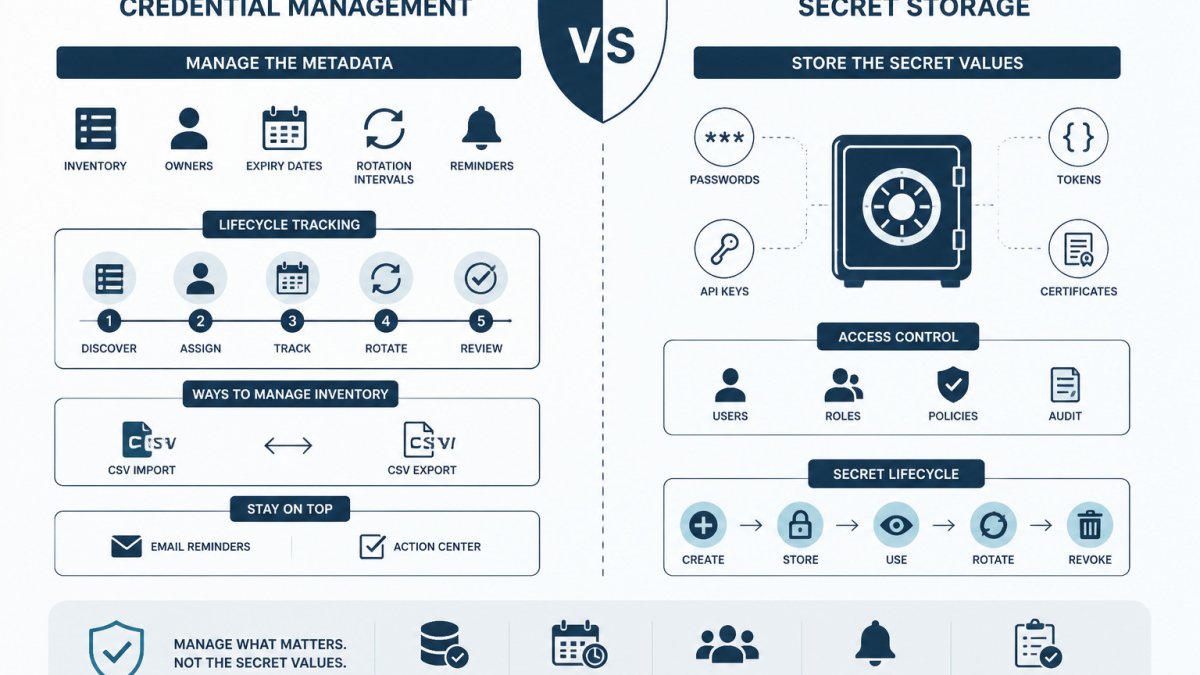
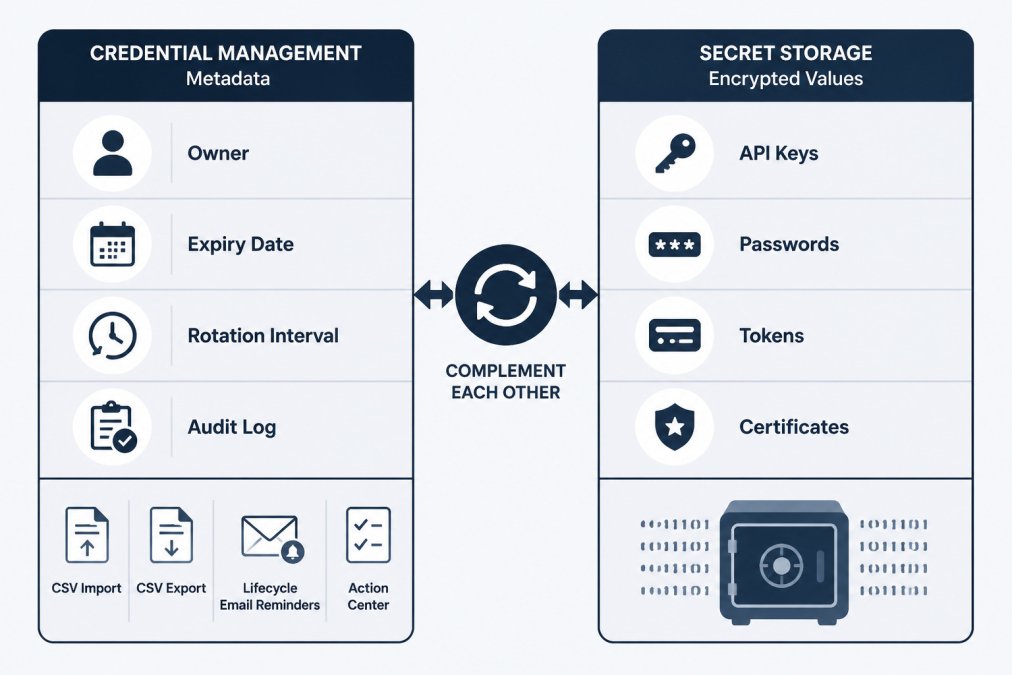
Credential management vs secret storage serve complementary functions: secret storage encrypts and controls access to actual secret values like API keys and passwords, while credential management tracks the lifecycle metadata, owner, expiry date, rotation interval, and audit history, without storing the values themselves. Both layers are needed for complete credential security and accountability.
- Secret storage (vaults) encrypts credentials at rest and in transit, controls access, and serves values to applications at runtime.
- Credential management tracks ownership, expiration dates, rotation schedules, and audit history across all your organization's secrets.
- A vault answers what is the value and who can retrieve it; lifecycle tracking answers what exists, who owns it, and when it expires.
- Credentials may be spread across vaults, cloud providers, CI/CD systems, and vendor dashboards; a unified inventory brings metadata together.
- Rotation frequency depends on risk level, provider requirements, and operational needs; document the policy and review it monthly.
Table of Contents
- Credential Management vs Secret Storage: Core Differences
- Building and Maintaining a Credential Inventory
- API Key Rotation Best Practices
- How Secrets Management Tools Fit Into Your Workflow
- Setting Up a Credential Rotation Schedule
- When to Use Each Approach
- Starting Your Credential Lifecycle Monitoring
- Frequently Asked Questions
Credential Management vs Secret Storage: Core Differences
Credential management and secret storage solve related but distinct problems, and the difference shapes how teams organize API keys, passwords, tokens, and certificates.
Secret storage (a secrets vault or secrets manager) holds the actual secret values: it encrypts API keys, database passwords, encryption keys, and tokens at rest, controls who can retrieve them, and logs access.
Credential management tracks the lifecycle of those secrets without storing the values.
What Credential Management Handles
Credential management focuses on visibility and accountability, answering operational questions vaults don't track well:
- Ownership: Who is responsible for rotating this API key?
- Expiration dates: When does this certificate expire?
- Rotation schedules: How often should this token rotate?
What Secret Storage Handles
Secret storage protects the actual values, encrypting credentials and controlling access:
- Encryption at rest: Secrets are encrypted when stored
- Access control: Only authorized users and services can retrieve secrets
- Encryption in transit: Secrets are encrypted when retrieved
A vault is where application code may retrieve an API key at runtime.
Building and Maintaining a Credential Inventory
A credential inventory lists every secret your organization uses, including where each one lives, who owns it, and when it expires. API keys, database connection strings, OAuth tokens, service accounts, SSH keys, and TLS certificates may be spread across platforms, cloud providers, and local configurations. An inventory brings the metadata together in one place, not the secrets themselves.
What to Track in Your Inventory
A minimal inventory includes:
- Credential name: What is this secret used for? (e.g., "Stripe API key - production")
- Type: API key, password, token, certificate, SSH key, encryption key
- Provider: Where is it stored? (Vault, AWS Secrets Manager, HashiCorp Vault, environment variables)
Optional fields help with planning: risk level, rotation method (automated, manual, or coordinated), dependent services (what breaks if it fails), and notes.
Assigning Owners and Accountability
Ownership is an important part of a working credential lifecycle. Clear owners help teams know who is responsible for rotations and whom to contact when a key fails. Learn how to assign owners to API keys as part of building accountability. Assign one primary owner per credential, responsible for knowing the expiry, planning and executing (or coordinating) the rotation, recording it when done, and alerting the team if the credential is compromised.
AWS documentation on credential management best practices
API Key Rotation Best Practices
API key rotation involves creating a new key, updating the service to use it, and retiring the old one. Rotation means creating a new key, updating the service to use it, and retiring the old one. The process varies by provider: some allow a grace period where both keys work, others require a hard cutover.
Planning Your Rotation Schedule
Rotation frequency depends on risk level, usage, provider requirements, and the team's operational needs. Set and document an interval appropriate to each credential.
Document the policy, share it with the team, and include it in onboarding. Learn how to track API key expiry dates and plan rotations before keys expire. Some keys have technical constraints: certificates expire on a fixed date (plan renewal 30 days ahead), OAuth tokens may auto-renew on short lifespans, SSH keys often rotate on staff changes, and database passwords require coordination across every service that uses them.
Recording and Auditing Rotation Work
After a rotation, record the rotation date, who performed it, the status (success or failure), and any notes. This record can help document the work and support troubleshooting if a service stops working afterward.
NIST guidelines on cryptographic key management
How Secrets Management Tools Fit Into Your Workflow
A secrets management tool, a vault or secrets manager, stores the actual secret values and controls runtime access.
How vaults and lifecycle tracking can differ:
- Ownership accountability. A vault's access logs and a credential ownership register serve different purposes.
- Expiry and rotation calendars. Vault capabilities vary by product and secret type. A separate metadata inventory can provide a cross-provider view of expiry dates and rotation schedules.
- Cross-provider inventory. Credentials may be recorded across cloud secret stores, CI/CD variables, Kubernetes Secrets, application config, and vendor dashboards.
This is the practical boundary between secret storage and credential lifecycle monitoring. The vault is the custody layer: it holds and serves values.
A common pattern uses both: the vault stores the secret, while a metadata inventory records owner, provider, expiry date, rotation interval, and audit history.
Operational trade-offs to weigh
These are general engineering trade-offs, not product claims.
- Availability and blast radius. A vault sits on the critical path for runtime retrieval; if it is unavailable, dependent workloads may fail to start or authenticate. A metadata inventory is not on that path, so an outage there affects planning and reminders, not running services.
- Latency. Runtime retrieval adds a network hop and authentication step; caching and sidecar patterns mitigate this but raise staleness and revocation-lag questions. Lifecycle metadata is read by humans and scheduled jobs, not request handlers.
- Vendor lock-in. Vault-specific features (dynamic secrets, lease renewal, plugins) are hard to port. A provider-neutral metadata inventory is easier to move because it stores descriptions, not values.
A simple decision guide
Use this as a starting point, then adjust for your team's size and risk tolerance.
| Situation | Secret storage (vault) | Lifecycle metadata record |
|---|---|---|
| Application needs a database password at runtime | Yes, retrieve from vault | Yes, record owner, rotation interval, last rotation |
| Third-party SaaS API key rotated manually in the vendor console | Optional, store value if the vendor supports it | Yes, track expiry, owner, rotation date |
| TLS certificate with a fixed expiry date | Not typically the certificate store | Yes, track expiry and renewal owner |
| SSH keys for infrastructure access | Optional | Yes, track owner and rotation on staff changes |
| Short-lived OAuth tokens that auto-refresh | Handled by the identity provider | Usually not needed unless a human owner must be recorded |
| Shared production credential used by several services | Yes | Yes, record dependencies and coordinating owner |
Neither layer is better; they answer different questions. A vault answers "what is the value, and who can read it?" A lifecycle record answers "what exists, who owns it, when does it expire, and when was it last rotated?"
HashiCorp Vault documentation on secrets management AWS Secrets Manager user guide
Setting Up a Credential Rotation Schedule
A rotation schedule is a calendar of which credentials are planned to rotate and when.
Determining Rotation Frequency
Choose rotation intervals based on your organization's requirements, provider guidance, and operational needs. See practical API key expiration policy examples and rotation checklists adapted for your team's risk profile.
Some credentials have technical limits. A certificate expires on a specific date, you can't rotate it more often than that. An OAuth token may refresh automatically, manual rotation doesn't apply. Document exceptions and explain why.
Coordinating Across Teams and Providers
Rotations may require coordination: a database password used by several microservices may require updating each one before the old password is retired. Build a rotation calendar showing credentials, responsible teams, dependencies, and planned timing. Communicate the schedule to owners. Track rotations as they happen; if one fails, document the reason and reschedule.
| Credential | Owner | Frequency | Next Rotation | Status |
|---|---|---|---|---|
| Production DB password | Alice | 60 days | Nov 15, 2026 | On track |
| Stripe API key | Bob | 90 days | Dec 1, 2026 | On track |
| GitHub deploy key | Carol | 180 days | Apr 15, 2027 | On track |
| AWS access key | Alice | 90 days | Oct 30, 2026 | Overdue |
When to Use Each Approach
Credential management vs secret storage is often conflated. The clearest way to decide is to separate the questions each answers, then map them to your workloads.
- Secret storage answers: What is the value, who or what can retrieve it, and is it encrypted at rest and in transit?
- Credential lifecycle management answers: What credentials exist, who owns each one, when does it expire, how often should it rotate, and when was the last rotation recorded?
Whether a team needs both depends on workload type and its requirements.
Decision framework by workload
| Workload or use case | Primary need | Secret storage role | Lifecycle metadata role |
|---|---|---|---|
| Web application reading a database password at startup | Runtime retrieval with access control | Strong, store and serve the value | Record owner, rotation interval, last rotation |
| CI/CD pipeline using deploy tokens | Short-lived access with audit | Strong, inject at runtime, avoid hardcoding | Record token owner and rotation date |
| Third-party SaaS API keys (payment, email, analytics) | Manual rotation in vendor console | Optional, depends on vendor support | Strong, expiry, owner, rotation reminders |
| TLS certificates | Fixed expiry, renewal coordination | Not typically a vault function | Strong, expiry tracking and renewal owner |
| SSH keys for server access | Identity-bound access | Optional | Strong, owner tracking, rotation on staff change |
| Service accounts across multiple clouds | Cross-provider visibility | Partial, each cloud has its own store | Strong, single inventory across providers |
| Short-lived OAuth tokens | Automatic refresh by identity provider | Handled by IdP | Usually minimal, record human owner only if needed |
| Shared production credential used by several services | Coordination across dependents | Strong | Strong, dependency list and coordinating owner |
Human identities versus machine identities
The split often falls along identity type.
- Human identities (engineers, operators, contractors) benefit most from lifecycle tracking: who has access, which credentials they own, what happens at offboarding, and when shared credentials rotate. A vault and an offboarding checklist serve different purposes.
- Machine identities (service accounts, API clients, workload identities) benefit most from secret storage at runtime, since the value must reach an application without human intervention. Lifecycle tracking still matters for credentials that cannot rotate automatically, third-party API keys, long-lived tokens, and certificates issued outside your cloud.
If a credential can be rotated by its issuing platform, follow that platform's documented process and record relevant lifecycle information. For credentials rotated manually, record the work in the inventory.
Overlap and limits
Be honest about where each falls short.
- Overlap: Both care about revocation and audit. A vault logs retrieval; a lifecycle record logs rotation and ownership changes. Neither alone gives a complete picture.
- Vault limits: Automatic rotation coverage varies by product and secret type, cross-provider inventory is usually out of scope, and ownership and offboarding are not native concepts.
- Lifecycle record limits: It cannot serve a secret at runtime, depends on humans or scheduled jobs to stay current, and drifts from reality if nobody records a rotation.
A practical starting checklist
Use this tool-neutral checklist to decide what to adopt first.
- List every credential you know about, API keys, database passwords, tokens, certificates, SSH keys, and note where each lives.
- Mark which are in a vault or managed secret store versus environment files, CI variables, or vendor dashboards.
- Mark which rotate automatically through a platform feature and which need manual work.
- Assign one owner per credential. If no owner is obvious, that is a finding, not a blocker.
- Record expiry dates and rotation intervals for the manual-rotation set first; lifecycle tracking pays off there soonest.
- Decide whether a vault is warranted for runtime secrets. If you have one, confirm which secret types it rotates automatically.
- Set reminders for upcoming expirations and rotations, and review the inventory monthly.
Small teams can start with a spreadsheet and a calendar. Consider formal lifecycle tracking when ownership, expiry, and rotation records need a more consistent process.
KeyGuardRail fits the lifecycle side of this framework: manual metadata entry, CSV import/export, ownership, expiry dates, rotation intervals, lifecycle email reminders, an Action Center, and audit history.
credential inventory template | /blog/credential-inventory-template getting started with KeyGuardRail | /getting-started
Starting Your Credential Lifecycle Monitoring
The first step is building an inventory. List credentials your organization uses, API keys, database passwords, tokens, certificates, and SSH keys.
Use the credential inventory template to get started; it includes fields for provider, owner, expiry date, and rotation interval, with fictional examples you can adapt. Then set up email reminders, review the rotation schedule monthly, and track completed rotations.
Frequently Asked Questions
What is the difference between credential management and secret storage?
Credential management tracks metadata about your credentials: who owns each API key or service account, when it expires, how often it should rotate, and a record of completed rotations. Secret storage keeps the actual credential values (passwords, tokens, keys) encrypted and access-controlled. They work together but serve different purposes. A vault stores the secrets themselves; a credential inventory stores the schedule and accountability layer.
Can a credential inventory replace a secrets vault?
No. A credential inventory cannot replace a vault. The vault protects the actual secret values and controls who can retrieve them. The inventory tracks ownership, expiry dates, and rotation work. Together they provide complementary records: the vault stores secret values, and the inventory tracks rotation schedules and ownership.
What metadata should a credential inventory track?
Track the credential name or identifier, the provider or system it belongs to, the owner or team responsible, creation and expiry dates, planned rotation interval, the date of the last rotation, and notes about dependencies or special handling. This metadata lets you see at a glance which credentials are expiring soon, who to contact for rotations, and whether a rotation is overdue.
How do secrets management tools and credential inventory work together?
The secrets manager stores and encrypts the actual credential values and controls access. The credential inventory sits alongside it and tracks when each credential should be rotated, who owns it, and records when rotations are completed. When your team rotates a key in the vault, you log that work in the inventory. This separation keeps secret values in the secrets manager while the inventory records lifecycle metadata.
